

Dua for Peace: Islamic Supplications for Calm
Anxiety does not announce itself. It arrives quietly, tightens around your chest, and leaves you searching for stillness. If you have ever reached that point, you already understand why the dua for peace is one of the most searched and sincerely sought practices in Islamic tradition. Millions of Muslims recite these supplications daily, not out of habit alone, but because they work, spiritually, psychologically, and practically.
This guide covers the most authentic and powerful duas for peace drawn from the Quran and verified hadith collections, explains exactly how and when to recite them, and gives you the grounding to make this practice a genuine anchor in your daily life.
What Is a Dua for Peace and Why Does It Matter
A dua (also written as du’a) is an Arabic word meaning supplication or invocation. It is the act of calling upon Allah directly, asking for His help, mercy, guidance, or protection. Unlike the five daily prayers (salah), which follow a fixed structure and set times, dua can be made at any moment, in any posture, in any language, and for virtually any need.
What elevates dua above a simple request is the theology behind it. The Prophet Muhammad (peace be upon him) said, as recorded in Sunan Ibn Majah and authenticated by Islamic scholars: “Dua is worship itself.” This single statement transforms supplication from a passive wish into an active spiritual act, one that strengthens your relationship with Allah every single time you engage in it.
The dua for peace of mind carries particular weight in Islamic tradition. Allah says in Surah Ghafir (40:60): “Call upon Me; I will respond to you.” This is not a Dua for Peace conditional promise. It is a divine guarantee, and it is the reason Muslims return to supplication in moments of grief, anxiety, and uncertainty, century after century.
In practice, dua also instills humility. Raising your hands in supplication is an acknowledgment that your own power has limits and that ultimate control belongs to Allah alone. Paradoxically, that acknowledgment produces one of the most freeing feelings a human being can experience.
The Islamic Foundation of Seeking Peace Through Dua
What the Quran Says About Inner Peace
Islam does not treat peace as a reward reserved for easy times. The Arabic word “salam” (peace) is so central to the faith that it forms the Islamic greeting, Assalamu Alaikum, exchanged dozens of times every single day. Peace is not peripheral to Islamic life. It is woven into its very fabric.
The most direct Quranic statement on the connection between supplication and inner peace appears in Surah Ar-Ra’d (13:28): “Verily, in the remembrance of Allah do hearts find rest.” The Arabic word used here is “tatma’inn,” which scholars of classical Arabic explain Dua for Peace carries a meaning of deep, settled stillness, not temporary relief but lasting contentment. Dhikr (remembrance of Allah), of which dua is a primary form, is directly linked by the Quran itself to this state of tranquility.
Surah Ash-Sharh (94:5-6) reinforces this further: “For indeed, with hardship will be ease. Indeed, with hardship will be ease.” Classical Quranic scholars note that the deliberate repetition of this verse is emphatic, not accidental. It teaches that peace and struggle coexist, and that ease is already embedded within difficulty for those who remember Allah.
The Prophetic Tradition of Daily Supplication
The Prophet Muhammad (peace be upon him) modeled a life structured around regular dua. He had specific supplications for waking up, for morning and evening, for before and after eating, for entering and leaving the home, and for moments of acute distress. This was not incidental. It was intentional spiritual maintenance.
Imam Ibn al-Qayyim, one of the most respected classical Islamic scholars, documented these prophetic prescriptions extensively in “Zaad al-Ma’aad.” He argued that the Prophet’s routine duas were a complete system for emotional and spiritual well-being, addressing states of grief, anxiety, fear, and loss with specific, targeted supplications.
The mistake most people make here is treating dua as a crisis tool only. What actually works is treating it as daily maintenance, the way you eat and sleep every day regardless of whether you feel hungry or tired. The Prophet’s practice confirms this: consistent supplication builds resilience before hardship arrives.
Dua for Peace of Mind: Authentic Supplications from the Quran and Sunnah
The Dua of Distress (Recorded in Sahih al-Bukhari and Sahih Muslim)
When you face acute anxiety or overwhelming worry, one of the most powerful supplications authenticated in both Sahih al-Bukhari and Sahih Muslim is the dua the Prophet (peace be upon him) recited in moments of distress:
Arabic: “La ilaha illa Allahu Al-‘Azeemu Al-Haleem, La ilaha illa Allahu Rabbu Al-‘Arshi Al-‘Azheem, La ilaha illa Allahu Rabbu As-Samawati wa Rabbu Al-Ardi wa Rabbu Al-‘Arshi Al-Kareem.”
Translation: “There is no god but Allah, the Mighty, the Forbearing. There is no god but Allah, the Lord of the Magnificent Throne. There is no god but Allah, Lord of the Heavens, Lord of the Earth, and Lord of the Noble Throne.”
This short dua for peace of mind operates on two levels simultaneously. Theologically, it reaffirms tawheed (the oneness of Allah), the bedrock of Islamic belief. Psychologically, it redirects your attention away from the source of anxiety and toward the boundless power and mercy of Allah. Reciting it three times in a moment of panic produces a measurable shift in mental state, not because of any mystical formula, but because it replaces a focus on your limitation with a focus on Allah’s unlimited ability.
The Dua for Grief and Anxiety (Sahih al-Bukhari)
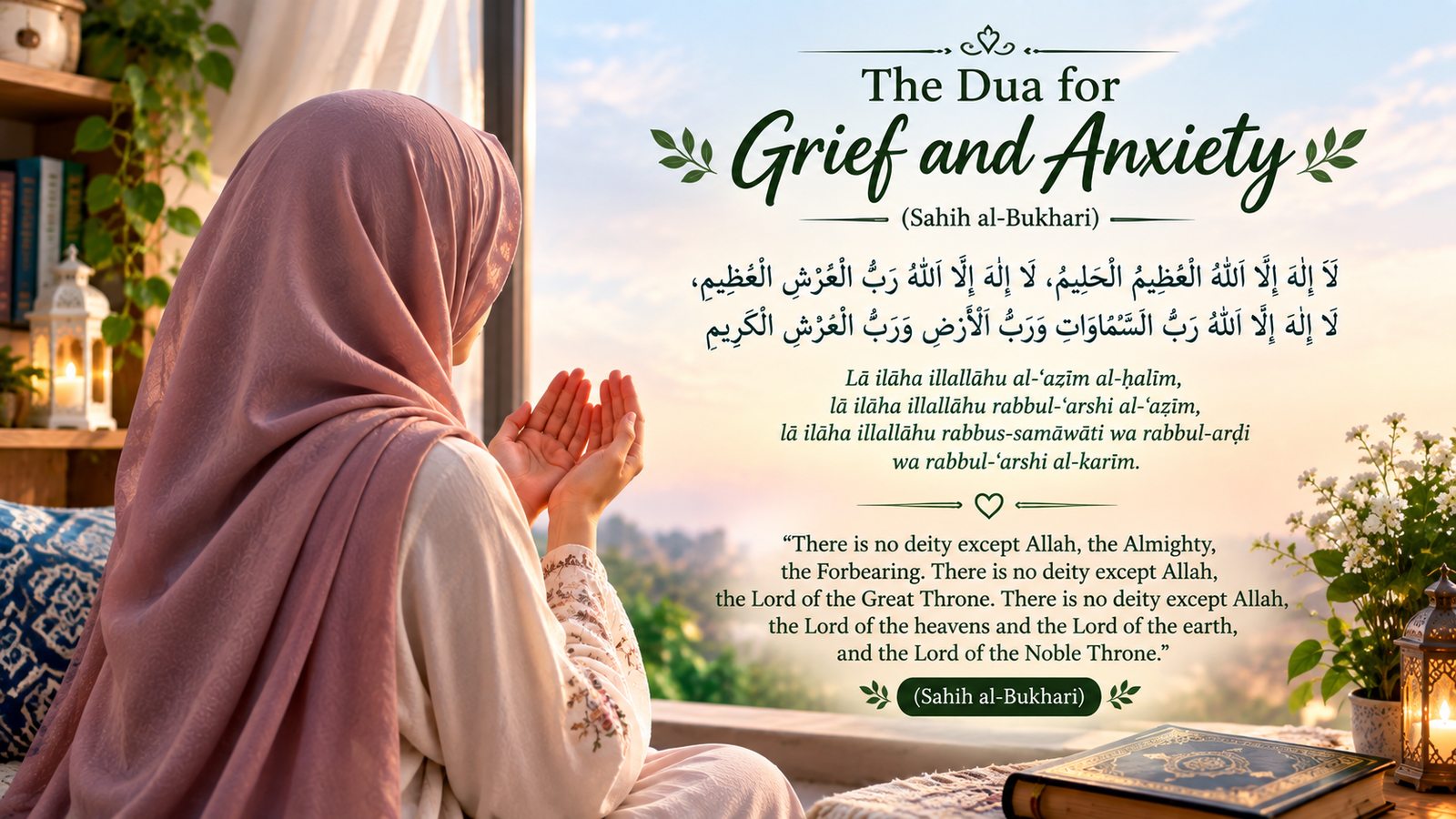
Another essential supplication for those seeking an Islamic dua for inner peace comes from a hadith in Sahih al-Bukhari. When the Prophet (peace be upon him) was afflicted with grief, he would say:
Arabic: “Allahumma inni abduka, ibnu abdika, ibnu amatika, nasiyati bi yadika, madin fiyya hukmuka, adlun fiyya qada’uka, as’aluka bi kulli ismin huwa laka, sammayta bihi nafsaka, aw allamtahu ahadan min khalqika, aw anzaltahu fi kitabika, aw ista’tharta bihi fi ilmil ghaybi indaka, an taj’alal Qurana rabia qalbi, wa nura sadri, wa jalaa huzni, wa dhahaba hammi.”
Translation: “O Allah, I am Your servant, son of Your servant, son of Your maidservant. My forelock is in Your hand. Your judgment upon me is executed, and Your decree concerning me is just. I ask You by every name that You have named Yourself, or revealed in Your Book, or taught to any of Your creation, or kept to Yourself in the knowledge of the unseen, to make the Quran the life of my heart, the light of my chest, the departure of my grief, and the vanishing of my anxiety.”
This supplication is remarkable for its completeness. It acknowledges Allah’s absolute authority, expresses personal submission, and asks not just for relief from a specific problem but for the Quran itself to become the source of sustained inner peace. In practice, scholars recommend reciting this dua consistently during periods of prolonged anxiety, not just acute crisis.
The Final Verse of Surah Al-Baqarah (2:286)
The last verse of Surah Al-Baqarah is both a dua and a declaration of mercy. The Prophet (peace be upon him) described it as a treasure from beneath the Throne of Allah, as recorded in Sahih Muslim:
Translation: “Our Lord, do not impose blame upon us if we forget or make mistakes. Our Lord, lay not upon us a burden like that which You laid upon those before us. Our Lord, burden us not with that which we have no ability to bear. And pardon us, grant us forgiveness, and have mercy upon us. You are our protector, so give us victory over the disbelieving people.”
Reciting this verse before sleep, as recommended in authentic narrations, serves as a dua for peace and protection throughout the night. It covers three essential human needs: forgiveness for shortcomings, relief from overwhelming burdens, and divine support.
Dua for Peace and Protection: Shielding Yourself from Harm
Supplications for Daily Protection
One of the most comforting truths in Islamic theology is that Allah’s protection is always within reach. The Quran and the Sunnah provide specific duas designed to shield believers from physical harm, spiritual danger, and the anxieties of the unseen.
Ayat al-Kursi (Surah Al-Baqarah, 2:255) is among the most powerful of these. The Prophet (peace be upon him) stated, as recorded in Sahih al-Bukhari, that whoever recites Ayat al-Kursi after each obligatory prayer, nothing stands between them and paradise except death. He also confirmed that reciting it before sleep places a guardian angel over the person until morning. This is the most widely recited Islamic dua for protection in the world.
The three Quls (Surah Al-Ikhlas, Surah Al-Falaq, and Surah An-Nas) form another complete system of protection dua. The Prophet (peace be upon him) recommended reciting them three times each morning and evening, explaining, as narrated in Abu Dawud, that they suffice for protection against everything. Surah Al-Falaq specifically addresses protection from harm, envy, and evil, while Surah An-Nas addresses protection from the whispering of Shaytan.
A Practical Morning Routine for Peace and Safety
Research on routine-based spiritual practice consistently shows that individuals who engage in structured daily prayer and supplication report higher levels of emotional resilience and significantly lower rates of anxiety disorders. For Muslims, this resilience is understood as a direct mercy from Allah in response to consistent, sincere supplication.
Here is a morning dua routine grounded entirely in authentic narrations:
- Upon waking, recite: “Alhamdulillahilladhi ahyana ba’da ma amatana wa ilayhin-nushur.” (Praise be to Allah who restored us to life after causing us to die, and unto Him is the resurrection.) Recorded in Sahih al-Bukhari.
- Recite Ayat al-Kursi once.
- Recite Surah Al-Ikhlas, Surah Al-Falaq, and Surah An-Nas three times each.
- Recite the morning adhkar from Hisnul Muslim, including: “Allahumma bika asbahna, wa bika amsayna, wa bika nahya, wa bika namutu wa ilayka an-nushur.” (O Allah, by You we enter the morning, by You we enter the evening, by You we live, by You we die, and Dua for Peace to You is the resurrection.)
This routine takes approximately ten minutes and establishes a spiritual anchor for the entire day. When the day becomes chaotic, you return to that anchor.
How to Make Your Dua for Peace More Effective
Conditions That Strengthen Your Supplication
Knowing the right words is only part of the practice. Understanding the conditions that strengthen dua transforms recitation into genuine connection. Islamic scholars, drawing from authentic hadith, identify several key factors:
- Sincerity of heart: Allah knows what is hidden. Dua made with genuine need and humility carries far more weight than words recited mechanically.
- Certainty of response: The Prophet (peace be upon him) warned in Sahih Muslim: “Let none of you say, ‘O Allah, forgive me if You will.’ Supplicate with resolve, for no one can compel Allah.” Ask with confidence.
- Choosing blessed times: Supplications made Dua for Peace during the last third of the night, between the adhan and iqamah, on Fridays between Asr and Maghrib, and while prostrating in salah carry particular weight according to authentic narrations.
- Beginning with praise and salawat: Opening your dua with praise of Allah and sending blessings upon the Prophet (peace be upon him) frames your supplication correctly and is confirmed in multiple hadith to strengthen the response.
- Persistence: The Prophet (peace be upon him) warned against impatience, Dua for Peace saying in Sahih Muslim that a person’s dua is answered as long as they do not become hasty and say, “I made dua but received no answer.”
Common Misconceptions About Dua for Peace
A widespread misconception is that dua for inner peace is only necessary during visible crisis. That is like saving water only for when you are already dehydrated. The prophetic model shows clearly that regular supplication during ordinary times builds the spiritual capacity to remain calm when hardship arrives.
Another misconception is that dua requires formal Arabic fluency. While reciting authenticated Arabic supplications is preferred and carries additional reward, the Prophet (peace be upon him) confirmed that dua can be made in any language. What Allah responds to is the sincerity of the heart, not the grammatical precision of the tongue.
Integrating the Dua for Peace into Your Daily Life
When and Where to Recite Peace Supplications
The beauty of dua for peace is its total accessibility. Unlike salah, it requires no wudu (though being in a state of ritual purity is encouraged), no specific direction, and no fixed location. You can make dua:
- During your morning routine, before the distractions of the day take hold
- In traffic, under your breath, when frustration begins to build
- Before entering a difficult meeting or conversation
- At night, when the mind races and sleep will not come
- Immediately after each obligatory prayer, when the door of response is wide open
In practice, the Muslims who report the greatest benefit from dua for peace are those who treat it as a conversational relationship with Allah, not a formal transaction. They speak to Allah about what is genuinely troubling them, in their own words, after reciting the authenticated supplications. This combination of prophetic supplication and Dua for Peace personal conversation reflects the complete picture of what Islamic dua truly is.
Building a Sustainable Supplication Practice
Sustainability is the key word here. A powerful dua recited once during a crisis and then abandoned will not produce the sustained inner peace that the Quran Dua for Peace promises in Surah Ar-Ra’d (13:28). What produces that result is consistency.
Start with one supplication. Choose the Dua of Distress from Sahih al-Bukhari and Sahih Muslim, memorize it, and commit to reciting it every morning for thirty days. Add a second dua after that becomes natural. Within a few months, you will have built an authentic, personalized daily dhikr practice rooted in the Sunnah and grounded in your genuine need for peace.
Key Takeaways
- The dua for peace is a direct, authenticated practice drawn from the Quran and the verified Sunnah of the Prophet Muhammad (peace be upon him), not a cultural ritual.
- Surah Ar-Ra’d (13:28) establishes a direct Quranic link between remembrance of Allah (including dua) and the deep, settled tranquility described by “tatma’inn.”
- The most effective duas for peace of mind include the Dua of Distress (Sahih al-Bukhari and Sahih Muslim), the Dua for Grief and Anxiety (Sahih al-Bukhari), and the final verse of Surah Al-Baqarah.
- Conditions that strengthen dua include sincerity, Dua for Peace certainty of response, choosing blessed times, and persistence without impatience.
- Treating dua as daily spiritual maintenance, not an emergency tool, is the prophetic model and the practice that produces lasting inner calm.
Frequently Asked Questions
What Is the Best Dua for Peace of Mind in Islam?
The most widely recommended dua for peace of mind, authenticated in both Sahih al-Bukhari and Sahih Muslim, is the Dua of Distress beginning with “La ilaha illa Allahu Al-‘Azeemu Al-Haleem.” It reaffirms tawheed and redirects attention from anxiety toward Allah’s unlimited power. Scholars also recommend the longer supplication from Sahih al-Bukhari starting with “Allahumma inni abduka” for sustained periods of grief or worry.
When Is the Best Time to Recite a Dua for Peace?
The Prophet Muhammad (peace be upon him) identified several times when supplication is especially powerful: the last third of the night (tahaj
What dua can I read when I feel anxious or worried?
You can recite the supplications taught by the Prophet Muhammad ﷺ for Dua for Peace distress and anxiety while placing your trust in Allah and seeking His help.
How often should I recite a dua for peace of mind?
There is no number required for most duas. You can make dua regularly and sincerely especially when you feel worried, overwhelmed or in need of Allah’s help.
Can dua help with stress and sadness in Islam?
Yes. Dua is a form of worship and a means of seeking comfort, strength and help from Allah. Along with dua Muslims are encouraged to practice patience, prayer, remembrance of Allah and trust, in Him.

Leave a Reply