
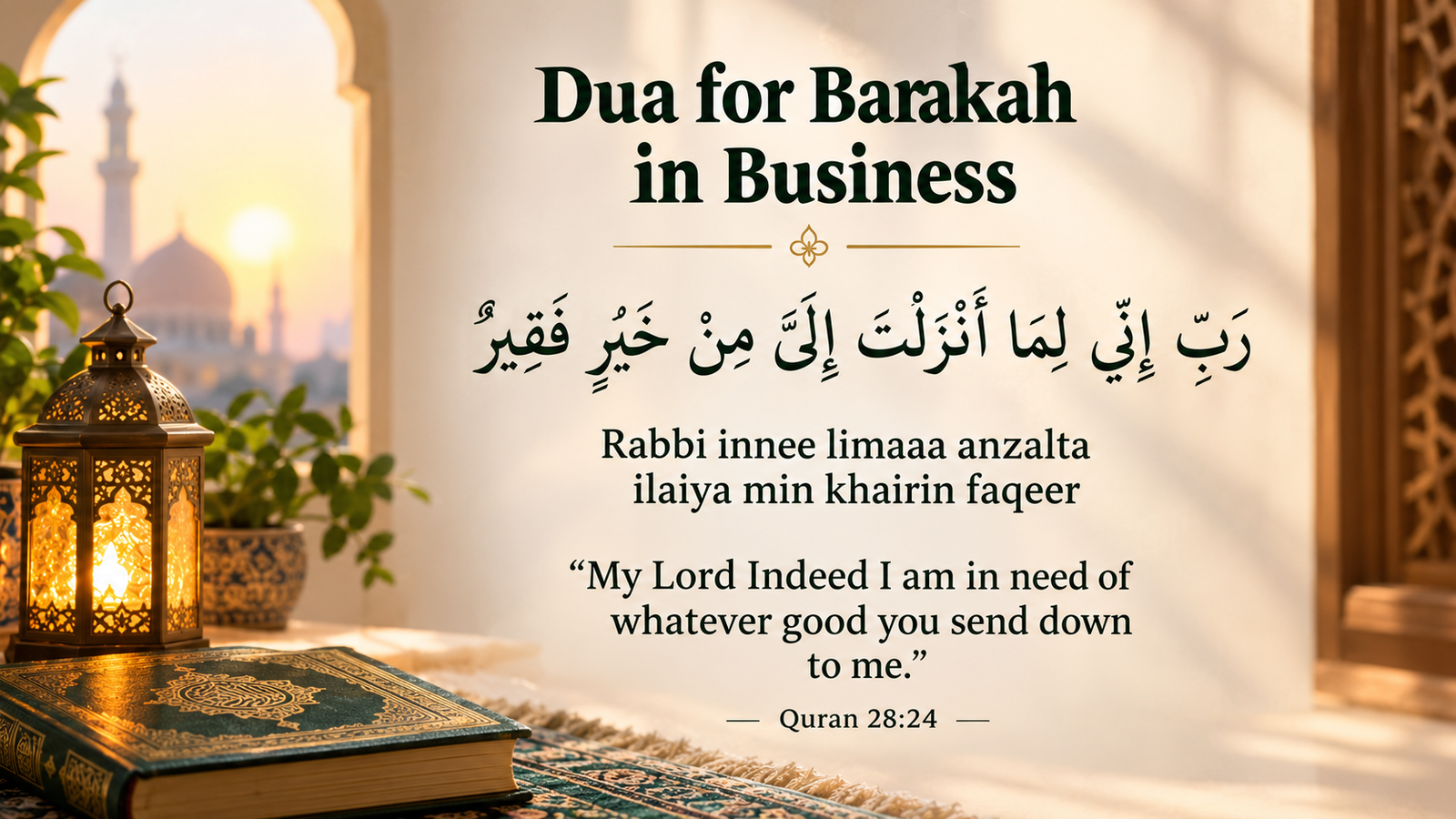
Dua for Barakah: 7 Authentic Supplications Every Muslim Should Know
Most Muslims assume barakah is something that simply happens to lucky people. It is not. Barakah is something you actively invite, and the Prophet Muhammad (peace be upon him) left you precise, authenticated words to do exactly that. This guide covers seven genuine duas for barakah drawn from the Quran and Sunnah, explains their sources, and shows you how to weave them into your daily life so that divine blessing becomes a consistent reality rather than an occasional hope.
Whether you are seeking blessings in your home, your income, your time, or your family, there is a specific and authenticated supplication for each of those needs. By the end of this article, you will know what to say, when to say it, and why it works.
What Barakah Actually Means (And Why Most People Misunderstand It)
Before you can ask for barakah with full conviction, you need to understand precisely what you are asking for. Many Muslims use the word loosely, treating it as a vague synonym for “good luck” or “prosperity.” That misses the depth entirely.
The Linguistic and Theological Root of Barakah
The Arabic word “barakah” (بركة) comes from the root “b-r-k,” which Arabic linguists connect to the image of a camel kneeling and remaining firmly planted in one place. Ibn Manzur, in his foundational lexicon Lisan al-Arab, explains this root as representing something simultaneously fixed, dua for barakah growing, and abundant.
In Islamic theology, barakah refers to the divine increase that Allah places in something beyond its apparent, dua for barakah measurable quantity. It is not simply having more. It is having enough that functions as if it is more.
Consider these concrete examples:
- A meal with barakah feeds more people than it logically should
- An hour of time with barakah produces more meaningful work than a full day without it
- A modest income with barakah covers more needs than a larger income that lacks it
Sheikh Ibn al-Qayyim al-Jawziyyah, in his Madarij al-Salikin, described barakah as “the continuous goodness from Allah that descends upon a thing and causes it to grow and sustain beyond its natural limits.” That single definition should motivate you to pursue barakah in every area of your life, not just occasionally, but as a daily discipline.
Why Barakah Is a Practical Necessity, Not a Spiritual Luxury
Here is something worth sitting with. Research published in the Journal of Muslim Mental Health (2020) found that Muslims who engaged regularly in personal dua and supplication reported significantly higher life satisfaction and dua for barakah a greater sense of sufficiency in daily resources, Blessings in Islam dua for barakah regardless of their actual income level. The feeling of “enough” did not come from having more money. It came from divine increase in what they already had.
This is the empirical echo of what Islamic scholars have taught for centuries. Barakah rewires how you perceive your life. It does not necessarily change the number in your bank account. It changes what that number is capable of doing.
Why Dua Is the Primary Channel for Inviting Barakah
Dua is not simply a request list you hand to Allah. In the Islamic framework established by the Prophet and his companions, dua is the foundational act through which a servant acknowledges complete dependence on the Creator.
The Prophet Muhammad (peace be upon him) stated, as recorded in Sunan al-Tirmidhi (Hadith 3370): “Dua is worship itself.” This is a remarkable declaration. Every time you raise your hands and call upon Allah for barakah in your rizq, your home, or your time, you are performing one of the highest acts of ibadah available to any believer.
Allah Himself commands this directly in Surah Ghafir (40:60): “And your Lord says, Call upon Me; I will respond to you.” This verse contains a divine promise, not a suggestion, not a maybe. When you make a sincere dua for blessings in Islam using authenticated words from the Quran and Sunnah, you are not simply hoping. You are claiming a promise Allah extended to every believer.
What makes authenticated duas for barakah especially powerful is their prophetic origin. When you use the exact words the Prophet (PBUH) used, you align your supplication with channels of communication that carry his spiritual legacy and divine approval.
The Most Powerful Dua for Barakah From the Quran
The Quran is your primary source for inviting divine blessing, and it contains several supplications that scholars specifically identify as carrying the quality of invoking barakah. These are not peripheral verses. They sit at the heart of the Quranic worldview on provision, sufficiency, and divine increase.
Three Quranic Supplications That Directly Invoke Barakah
- The Dua of Ibrahim (peace be upon him) in Surah Ibrahim (14:37)
Ibrahim asked Allah to bless his family and descendants with provision and gratitude. The Arabic reads:
“Rabbana innee askantu min dhurriyyatee biwadin ghayri dhee zar’in ‘inda baytika al-muharram, Rabbana liyuqeemu as-salata, faj’al af’idata mina an-naasi tahwee ilayhim warzuqhum mina ath-thamarati la’allahum yashkuroon.”
(Our Lord, I have settled some of my descendants in an uncultivated valley near Your sacred House. Our Lord, that they may establish prayer. So make hearts among the people incline toward them and provide for them from fruits that they might be grateful.)
This dua explicitly connects divine provision to gratitude, and scholars note it as a model supplication for seeking barakah in family and livelihood.
- Surah Al-Baqarah (2:201)
“Rabbana atina fid-dunya hasanatan wafil-akhirati hasanatan waqina ‘adhaban-naar.”
(Our Lord, give us in this world that which is good and in the Hereafter that which is good, and protect us from the punishment of the Fire.)
Imam al-Tabari, in his Tafsir, explains that the word “hasanah” (goodness) in this verse encompasses barakah across every worldly and spiritual affair. This brief, elegant dua covers an extraordinary range of needs in a handful of words.
- Surah Al-Araf (7:96) as a Reflective Anchor
“And if only the people of the cities had believed and feared Allah, We would have opened upon them blessings from the heaven and the earth.”
Sheikh Wahbah al-Zuhayli, in Al-Tafsir al-Munir, notes that regularly reading and reflecting on this verse functions as a spiritual reminder that barakah flows from taqwa (God-consciousness). Reciting it with intention prepares the heart to receive divine increase.
How to Recite Quranic Duas for Barakah Correctly
Technique matters here. Based on classical Islamic scholarship, here is the proper method:
- Begin in a state of wudu (ritual purity), which scholars broadly recommend for Quranic recitation
- Seek refuge from Shaytan by saying “A’udhu billahi minash-shaytanir-rajeem”
- Open with “Bismillah ir-Rahman ir-Rahim”
- Recite with tadabbur, slow and reflective recitation rather than rushing through the words
- Make the supplication with your heart fully present, not just your tongue
Imam al-Nawawi, in his encyclopedic Al-Adhkar, emphasizes that a dua recited without heart engagement does not carry its full spiritual weight. Sincerity of heart is one of the primary conditions scholars list for dua acceptance.
Authentic Prophetic Duas for Barakah From the Sunnah
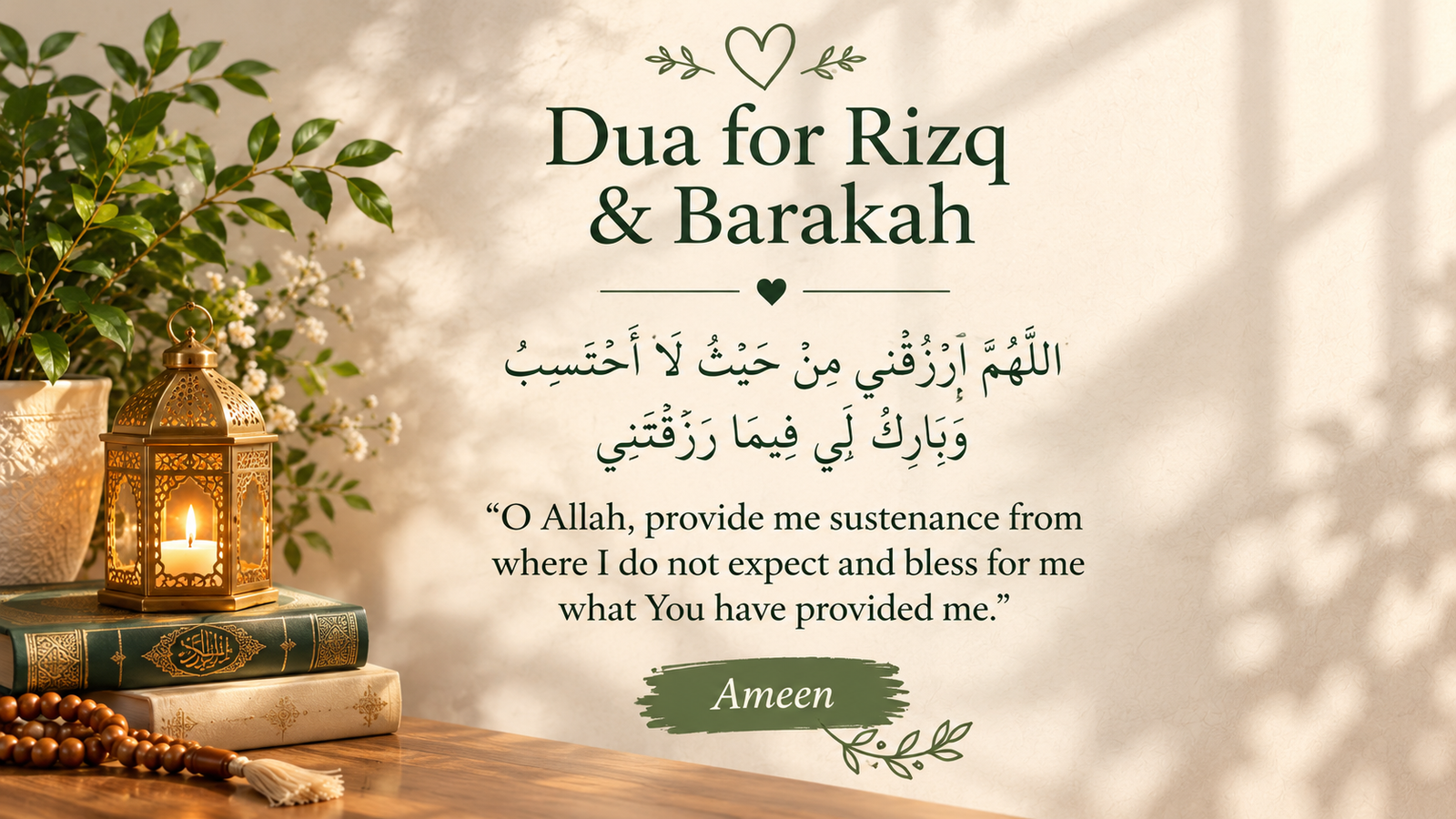
Beyond the Quran, the authenticated hadith collections preserve an extraordinary treasury of Islamic prayers for barakah. The Prophet Muhammad (PBUH) taught specific supplications for specific situations, many transmitted through strong chains of narration.
Dua for Barakah in Food and Provision
The Prophet (PBUH) said, as recorded in Sunan Ibn Majah (Hadith 3286): “Allahumma barik lana fima razaqtana waqina ‘adhaban-naar.”
(O Allah, bless us in what You have provided us and dua for barakah protect us from the punishment of the Fire.)
This supplication is ideally recited before meals and in any moment of gratitude for provision. It explicitly asks Allah to place barakah in your rizq rather than simply asking for more. The distinction is significant. You are not asking for quantity. You are asking for divine increase in what you already have.
In practice, reciting this before family meals transforms the act of eating from a physical routine into an act of worship, a moment of actively inviting blessing into your sustenance.
Dua for Barakah in Time and Productivity
One of the most practically powerful supplications for barakah in time comes from the morning adhkar. The Prophet (PBUH) taught his companions to seek blessings dua for barakah at the start of each day, and scholars including Ibn al-Qayyim have noted that the early morning hours carry particular divine barakah.
Reciting the following after Fajr prayer:
“Allahumma inni as’aluka ‘ilman nafi’an wa rizqan tayyiban wa ‘amalan mutaqabbalan.”
(O Allah, I ask You for beneficial knowledge, pure provision, and accepted deeds.)
This supplication, recorded in Sunan Ibn Majah (Hadith 925), directly ties barakah in knowledge, provision, and deeds together in a single request. Many Islamic scholars recommend making it a fixed part of your post-Fajr routine precisely because the morning hours are described in hadith as carrying special divine increase.
Dua for Barakah in a New Home or Business
When starting something new, whether it is moving into a new home, launching a business, or making a significant purchase, the mixture of excitement and responsibility is real. As a Muslim, you understand that success in any new endeavor does not rest on planning or effort alone. It depends on the barakah Allah places in it.
The Sunnah directs believers entering a new home to pray two units of voluntary prayer (nafl) and then recite:
“Allahumma inni as’aluka khayra al-mawlaji wa khayra al-makhraj, bismillahi walajnaa wa bismillahi kharajnaa wa ‘ala Allahi rabbina tawakkalna.”
(O Allah, I ask You for the goodness of the entering and the goodness of the exiting. In the name of Allah we enter, and in the name of Allah we leave, and upon Allah our Lord we rely.)
This supplication, sourced from Abu Dawud (Hadith 5096), establishes the home as a place consecrated under Allah’s protection and barakah from the very first moment you cross the threshold.
For a new business or financial endeavor, dua for barakah scholars recommend combining this with a sincere istikhara prayer and reciting Surah Al-Baqarah in the new space, as the Prophet (PBUH) stated that Shaytan does not enter a home where Al-Baqarah is recited.
Dua for Barakah in Marriage and Family
“Barakallahu laka wa baraka ‘alayka wa jama’a baynakuma fi khayr.”
(May Allah bless you and send blessings upon you and bring you together in goodness.)
This is the authenticated supplication the Prophet (PBUH) taught for congratulating a newly married couple, recorded in Sunan Abu Dawud (Hadith 2130) and graded sahih by al-Albani. It is not merely a social expression. It is a specific, targeted dua for barakah that invokes divine blessing dua over the marriage itself, not just the couple.
The mistake most people make here is treating it as a formal pleasantry rather than a sincere supplication. Recite it with full intention, raising your hands if possible, and let your heart accompany the words.
Dua for Barakah in Knowledge and Learning
“Rabbi zidni ‘ilma.”
(My Lord, increase me in knowledge.)
This single-line supplication from Surah Ta-Ha (20:114) is among the shortest duas in the Quran, and among the most powerful. Scholars of tafsir note that Allah commanding the Prophet to ask for increase in knowledge above all else signals the supreme value of beneficial knowledge in Islam. Knowledge with barakah is knowledge that transforms the one who holds it and benefits those around them.
Recite this before studying, before teaching, before reading Quran, and before any gathering where knowledge is shared.
Dua for Barakah When Making a Purchase
“Allahumma barik lahu fima a’tayta wa barik lahu fima a’tahu.”
(O Allah, bless him in what You have given him, and bless him in what he has given.)
This supplication is recorded in various hadith collections as a dua the Prophet (PBUH) encouraged when completing a financial transaction. It shifts the focus of commerce from pure transactional exchange to a moment of mutual blessing, dua for barakah a practice that reflects the Islamic understanding that every financial interaction can carry or drain barakah depending on your intention and supplication.
Dua for General Barakah in All Affairs
“Allahumma inni as’aluka al-barakah fi umri wa fi rizqi wa fi ‘amaliy.”
(O Allah, I ask You for barakah in my life, in my provision, and in my deeds.)
While this particular formulation does not appear as a single hadith, it draws directly from Quranic language and dua for barakah prophetically approved terminology for seeking divine increase. Scholars including Sheikh Salih al-Munajjid of IslamQA have noted that supplications built from authenticated Quranic and Prophetic terms are valid and encouraged, particularly when they summarize genuine need.
This dua works best as part of your daily morning and evening adhkar, pairing it with the authenticated fortress supplications from Hisnul Muslim.
How to Build a Daily Practice Around Duas for Barakah
Knowing the supplications is only part of the equation. What actually produces lasting change is consistent, structured practice. Here is a framework drawn from classical Islamic scholarship on the optimal conditions for dua acceptance.
The Four Conditions Scholars Identify for Dua Acceptance
- Sincerity (Ikhlas): Your intention must be for Allah alone, not for appearance or habit
- Presence of heart (Khushu): Recite with full attention, not on autopilot
- Certainty (Yaqeen): Believe with conviction that Allah hears and will respond in the best way
- Persistence (Istimrar): Make dua regularly, not only in crisis moments
Imam al-Ghazali, in Ihya Ulum al-Din, teaches that these four conditions are not checkboxes but qualities of the soul that grow through practice. The more consistently you make dua for barakah, the more sincerely and confidently you will do it over time.
Practical Moments to Embed Duas for Barakah in Your Day
- After Fajr prayer: Recite the dua for barakah in time, knowledge, and provision
- Before every meal: Recite the dua for barakah in food
- When entering your home: Recite the dua for entering and acknowledge Allah’s barakah on your household
- Before any financial transaction: Recite the dua for purchase barakah
- Before learning or work: Recite “Rabbi zidni ‘ilma”
- Before sleeping: Review your day and make a general dua for barakah in your affairs
The goal is not to add pressure to your day. It is to transform ordinary moments into intentional ones, which is itself a form of barakah.
Key Takeaways
- Barakah is divine increase beyond natural quantity. It is active, real, and something you invite through specific supplications.
- The dua for barakah carries its maximum power when recited with sincerity, presence of heart, and consistent practice, not just in moments of crisis.
- The Quran and Sunnah provide authenticated, dua for barakah targeted duas for barakah in food, time, marriage, knowledge, commerce, and the home.
- Using the exact words from the Quran and authentic hadith aligns your supplication with prophetically approved channels and carries a weight that improvised words alone do not.
- Barakah is not separate from taqwa. Surah Al-Araf (7:96) directly links God-consciousness to the opening of heavenly and earthly blessings.
Frequently Asked Questions
What is the best dua for barakah?
You can ask Allah to bless your wealth your time, your health, your family and dua for barakah your daily activities. Sincere dua and sincere gratitude are ways to seek barakah.
How can I get barakah in my life?
Pray every day earn income that is allowed by Allah give money to those in need be thankful to Allah keep relationships with your family and use your time well.
Can I make a prayer, for blessings in my family?
Yes you can ask Allah to fill your family with love, peace, good health and strong belief.
Does barakah only mean having money?
No. Barakah means goodness and blessings. It can include peace of mind, beneficial knowledge, good health, dua for barakah sufficient provision and valuable time.




Leave a Reply