Dua for Good Luck in Islam: 7 Authentic Supplications
Dua for Good Luck in Islam: 7 Authentic Supplications That Actually Work
Looking for a dua for good luck in Islam? You are not alone. Millions of Muslims search for exactly this before exams, job interviews, and major life decisions. The good news: the Quran and Sunnah give you precise, sourced supplications for every situation. The honest clarification: Islam does not frame outcomes as luck. It frames them as responses from Allah to your effort, your sincerity, and your trust.
This guide gives you seven authentic duas for good luck and success in Islam, drawn from named sources in the Quran and Sunnah. You will learn which dua fits which situation, how to wish someone else success the Islamic way, and what actually strengthens a supplication beyond the words themselves.
What Islam Teaches About Luck and Why It Matters for Your Dua
Islam replaces the concept of luck with two more precise ideas: barakah and tawakkul. Barakah is the blessing Allah places inside a thing, a business, a relationship, Dua for Good Luck in Islam a moment. Tawakkul is your conscious decision to trust Allah after you have done your part. When a person searches for a dua for good luck in Islam, what they are really reaching for is one of these two: either the blessing of a good outcome, or the peace of trusting that the outcome is in capable hands.
This distinction matters practically. A dua for luck asks chance to cooperate. A dua for barakah asks Allah directly. The first has no object. The second has a listener.
According to Islamic Relief Canada, supplication is a direct line of communication with Allah, with a corresponding prayer for every situation and feeling a believer can experience. That framing turns “good luck” from a vague wish into a specific, Dua for Good Luck in Islam addressable request.
The Prophet’s Teaching on Effort and Trust
The Prophet Muhammad (peace be upon him) was asked whether a man should tie his camel or leave it and trust Allah. He replied: “Tie it, then put your trust in Allah.” This hadith, referenced by Amaliah, is the foundation for every dua here. Prepare for the interview. Study for the exam. Check the contract. Then ask. The dua is not a substitute for effort. It is what you do after the effort is complete.
The Best Dua for Good Luck in Islam: Three Core Supplications
Three short supplications cover most of what people mean when they hope for good fortune. Each comes from a named source, and each takes under ten seconds to say.
1. Dua for Good in This World and the Hereafter (Surah Al-Baqarah 2:201)
This is the most cited dua in the Quran for comprehensive success. MuslimSG presents Surah Al-Baqarah 2:201 as the verse that asks Allah for good in this life and the Hereafter, Dua for Good Luck in Islam alongside protection from the Fire. Islamic Relief Canada lists the same words as a dua to your Lord for good in both lives.
The Arabic is:
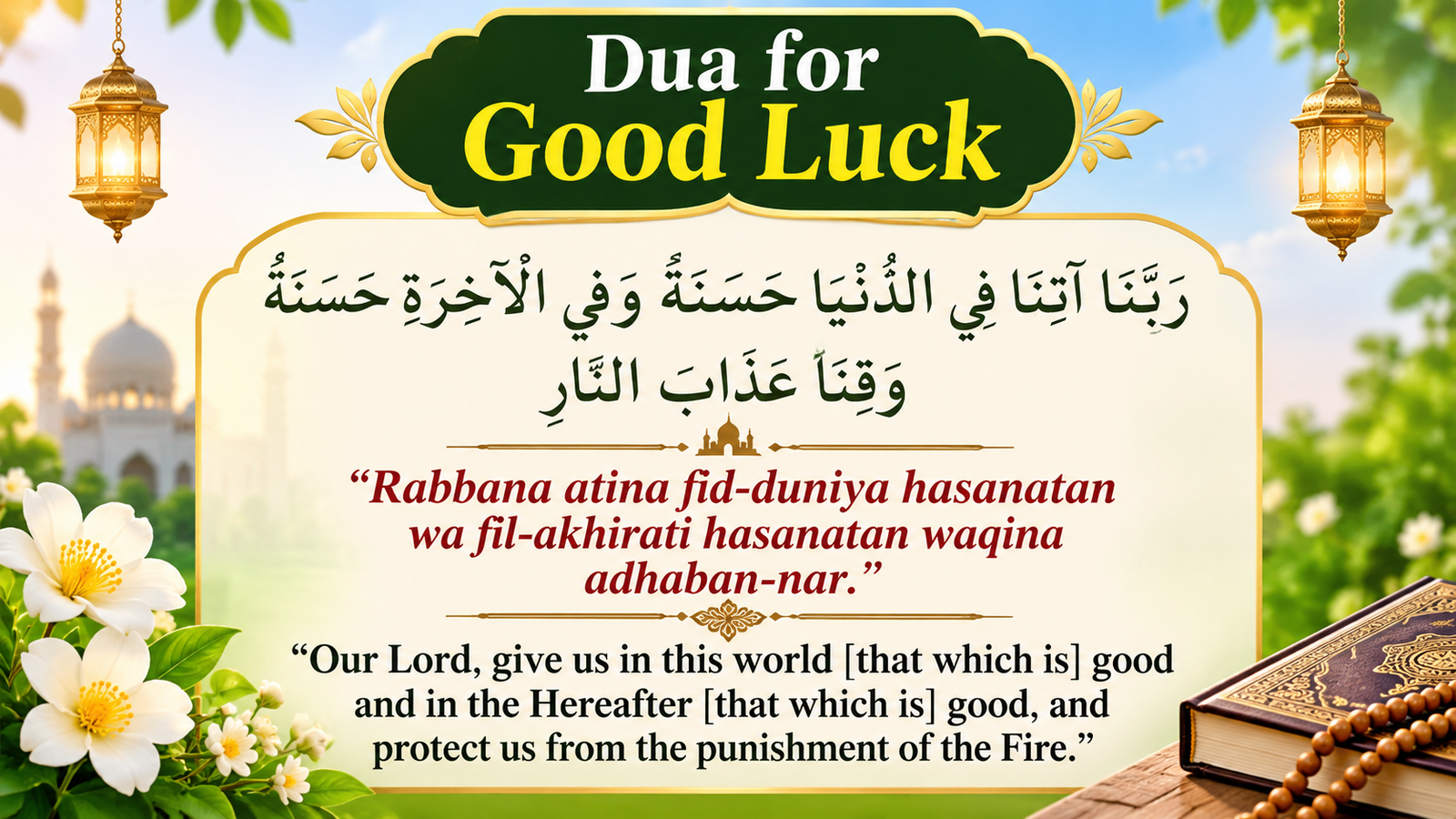
Rabbana atina fid-dunya hasanatan wa fil-akhirati hasanatan waqina ‘adhaban-nar
Translation: “Our Lord, give us good in this world and good in the Hereafter, and protect us from the punishment of the Fire.”
Notice the scope. You are not asking for one win. You are asking for a result you will still be glad of in the Hereafter. That long view is precisely what separates Islamic supplication from a wish for luck.
2. Dua Asking Allah to Make an Action Destined, Easy and Blessed
Islamic Relief Canada presents a dua asking Allah to make an intended action destined, easy and blessed, on the condition that it is good for you. That conditional clause is theologically significant. You are handing the final judgment to the One who sees consequences you cannot.
This is a natural dua for good luck in exams. Say it after your revision is finished, Dua for Good Luck in Islam before you open the question paper. It acknowledges both your effort and your limits.
3. Allahumma Inni As’aluka Min Fadlika
Amaliah gives this short supplication the translation: “O Allah, I ask for Your favour.” It is easy to memorise, works in almost any setting, and requires no long recitation. Say it in a hallway before a meeting, Dua for Good Luck in Islam during a car ride, or in the minute before you open an email you have been dreading. Its brevity is a feature, not a limitation.
Duas for Specific Goals: Interviews, Business and Provision
General duas cover broad needs. These three fit precise moments in a working and professional life.
4. Dua for Interviews and Presentations (Surah Ta Ha 20:25-28)
MuslimSG recommends Surah Ta Ha 20:25-28 specifically for interviews and presentations. In these verses, the Prophet Musa (Moses) asks Allah for:
- An uplifted, expanded heart
- Ease in his tasks
- A freed and eloquent tongue
This is the most targeted dua for good luck before a job interview or public speech that the Quran offers. Say it quietly in the waiting room, Dua for Good Luck in Islam or in the final minute before you are introduced. It addresses nerves about words and communication more directly than any other supplication in this list.
5. Dua for Business and Beneficial Provision (Sunan Ibn Majah)
MuslimSG attributes this dua to Sunan Ibn Majah. The transliteration, as Amaliah records it, is:
Allahumma inni as’aluka ‘ilman naafi’an, wa rizqan tayyiban, wa ‘amalan mutaqabbalan
Translation: “O Allah, I ask You for beneficial knowledge, good provision, and deeds that will be accepted.”
Notice what this dua does not request: a windfall, a shortcut, or a competitor’s failure. It asks for income that is clean, work that is accepted, Dua for Good Luck in Islam and knowledge that is useful. That makes it a principled start to any workday or new venture. It is the Islamic analogue of asking for sustainable success rather than sudden fortune.
6. Dua for Patience When Results Are Delayed (Surah Al-A’raf 7:126)
Sometimes you have done the work and the answer has not arrived. MuslimSG cites Surah Al-A’raf 7:126, in which believers ask Allah to pour out patience upon them and to let them die as Muslims. Read it as a request for steadiness during a waiting period, Dua for Good Luck in Islam not only for a better outcome to arrive faster.
If you are in a slow season and can hold onto only one dua, choose this one. It steadies the heart first, which makes everything else more bearable.
7. Seeking Forgiveness as a Gateway to Provision (Surah Nuh 71:10-12)
This supplication draws on the Quranic account in which the Prophet Nuh (Noah) tells his people that consistent seeking of forgiveness will cause Allah to send rain in abundance, increase wealth, Dua for Good Luck in Islam give them children, and place gardens and rivers at their disposal. While this is not a “good luck” dua in the casual sense, it reflects a Quranic principle: that turning sincerely to Allah opens doors in the material world. Many scholars recommend making istighfar (seeking forgiveness) before any major supplication as a way of clearing the path.
Dua for Good Luck in Islam: How to Wish Someone Else Well
Phrases That Point to Allah Rather Than Chance
When a friend faces an exam, an interview, Dua for Good Luck in Islam or a difficult decision, Muslims reach for phrases that name Allah rather than invoke abstract fortune. The most practical options are:
- Barakallahu feek (“May Allah bless you”)
- Allah yosahhil lak (“May Allah make it easy for you”)
- Allah yewafuqak (“May Allah grant you success” – from tawfiq)
- Bi’idhnillah (“With Allah’s permission”) – used before an event
- In sha Allah (“If Allah wills”) – acknowledges His control over outcomes
These phrases are short enough to say in a hallway or send in a text message. Each one plants a small dua where a casual “good luck” would have been.
Making Dua Privately for Family and Friends
A spoken wish lasts seconds. A private dua can be as long and specific as you like. Mention the person by name, Dua for Good Luck in Islam ask for what they actually need, and make the dua when they are not present. MuslimSG cites a hadith stating that a virtuous descendant who prays for a parent continues to benefit that parent even after death. Praying for your loved ones is not a small gesture. It is a gift that outlasts the moment.
How to Strengthen Any Dua for Good Fortune and Success
Sincerity, Good Character and a Settled Heart
The words of a dua matter. The person saying them matters equally. MuslimSG names good character and patience as the two core attributes that position a person for success. Surah Ash-Shams 91:9-10 makes this explicit: whoever purifies their soul succeeds, and whoever corrupts it fails.
In practice, this means that before you raise your hands and ask, it is worth spending a moment on housekeeping: settling disputes, dropping a shady shortcut, Dua for Good Luck in Islam returning something borrowed. A sincere dua begins with a clean intention, not a polished recitation.
Raise Your Hands and Wait With Contentment
Amaliah describes tawakkul as asking Allah for your needs with raised hands, then waiting contentedly for the answer to arrive, whether in this life or the next. That last phrase is load-bearing. A delayed answer is not a refused one. The response may arrive in a form you did not request but that serves you better than the form you imagined.
Keep asking. Islamic Relief Canada quotes the Prophet Muhammad (peace be upon him) as saying nothing is dearer to Allah than a servant who keeps making dua. Repeating your request never exhausts your welcome.
Your Next Step: Choose One Dua and Begin Today
Good fortune in Islam is not a matter of chance. It is a request made to the One who controls outcomes, backed by honest effort and a patient heart. This week, pick the single dua that fits your situation most closely, Dua for Good Luck in Islam whether that is the Surah Al-Baqarah verse for broad success, the Surah Ta Ha verses for an interview, or the Sunan Ibn Majah supplication for a new business.
Learn the Arabic if you can. Keep the meaning in front of you as you recite. Do your part thoroughly. Then leave the outcome with Him. Come back to the dua as often as you need to. Asking is never wasted.
Key Takeaways
- Islam replaces “luck” with tawakkul (trust in Allah) and barakah (blessing). A dua for good luck in Islam asks for a specific, Allah-granted outcome, not random chance.
- Effort comes first. Tie your camel, then make your dua. Supplication is not a substitute for preparation.
- Seven authentic duas cover general good, Dua for Good Luck in Islam ease in a task, interviews, business, patience in waiting, and the purifying role of seeking forgiveness.
- When wishing others well, use phrases that name Allah (barakallahu feek, Allah yosahhil lak) rather than invoking luck.
- Sincerity, good character, and contentment while waiting are what strengthen a dua beyond the words themselves.
Frequently Asked Questions
What is a good dua to say for good luck in Islam?
A short and practical choice is “Allahumma inni as’aluka min fadlika,” which Amaliah translates as “O Allah, I ask for Your favour.” It asks directly for good without framing it as luck, Dua for Good Luck in Islam and you can say it before almost any task or decision. For a more comprehensive supplication, Surah Al-Baqarah 2:201 asks Allah for good in this world and the Hereafter simultaneously.
What is the most powerful dua for success before an interview or exam?
Surah Ta Ha 20:25-28 is specifically recommended by MuslimSG for interviews and presentations, because it asks Allah for an open heart, ease in tasks, and an eloquent tongue. For exams, the dua from Islamic Relief Canada asking Allah to make an action destined, easy and blessed (on the condition it is good for you) fits equally well and can be said right before you begin the paper.
Which surah brings good luck and blessings in Islam?
No classical Islamic source describes any surah as a vehicle for luck, because luck implies randomness and Islam does not. What the sources offer are specific verses for specific needs. Surah Al-Baqarah 2:201 covers broad worldly and spiritual success. Surah Ta Ha 20:25-28 addresses communication and interview situations. Surah Nuh 71:10-12 connects sincere repentance to increased provision and blessings in the material world.