

Dua for Parents: The Most Powerful Supplications Every Muslim Should Know
Most Muslims memorize a dua for parents early in life, but very few understand the full spiritual weight behind those words. When you raise your hands and ask Allah to have mercy on the two people who gave you everything, you are performing one of the most beloved acts in all of Islamic worship. This guide covers the essential supplications for your parents, whether they are alive or have passed, the best times to make them, and the Quranic and prophetic foundations that make these duas so profound.
What Is Dua for Parents and Why It Matters in Islam
Dua is supplication. It is the act of calling upon Allah with genuine need, gratitude, and hope. When you direct that call toward the wellbeing of your parents, dua for parents Islamic scholarship unanimously places it among the highest acts of worship a believer can perform.
The Prophet Muhammad (peace be upon him) said, “Dua is worship.” (Tirmidhi, classified as sahih, narrated by Abu Hurairah RA). That framing matters. Making a dua for your parents is not a cultural formality or a sentimental habit. It is a direct act of ibadah with real spiritual consequence.
Here is the theological anchor that makes this so significant. The Prophet (peace be upon him) said, “The pleasure of Allah is in the pleasure of the parents, and the anger of Allah is in the anger of the parents.” (Tirmidhi, classified as sahih by Al-Albani). Your relationship with your parents and your relationship with Allah are spiritually inseparable. Praying for them is praying toward Allah at the same time.
There is also a practical dimension that many Muslims overlook. Dua made for someone in their absence, known as dua al-ghayb, carries its own specific reward. A hadith in Sahih Muslim states that when you make dua for another person without their knowledge, dua for parents an angel responds “Ameen, and the same for you.” Imagine the return when that supplication is directed toward the very people through whom Allah brought you into the world.
The Quranic Foundation: What Allah Says About Parents
The Quran does not treat kindness to parents as optional. It places it immediately alongside the command to worship Allah alone. In Surah Al-Isra (17:23), Allah says, “And your Lord has decreed that you worship none but Him, and that you be dutiful to your parents.”
That pairing is deliberate and theologically striking. Ibn Kathir, in his widely referenced tafsir, notes that the juxtaposition of tawhid (monotheism) and birr al-walidain (dutifulness to parents) signals that honoring parents ranks second only to worshipping Allah. That is an extraordinary claim, and it is not a marginal opinion. It reflects mainstream Islamic scholarly consensus across centuries.
The Sunnah reinforces this at every level. In a narration recorded in both Bukhari and Muslim, a companion asked the Prophet (peace be upon him) which deed is most beloved to Allah. The Prophet said, “Prayer at its proper time.” The companion asked what comes next. The Prophet replied, “Dutifulness to parents.” Jihad came third. Being dutiful to parents, which includes making regular supplication for them, outranked one of the most demanding physical acts in Islam.
Understanding this foundation transforms how you approach a parent dua. It is not a cultural habit. It is a deeply grounded spiritual obligation with documented prophetic endorsement.
The Most Powerful Dua for Parents from the Quran
Of all the supplications Islam provides for parents, one stands above the rest in its directness, its Quranic origin, and the depth of meaning packed into a single sentence. This is the dua from Surah Al-Isra, verse 24, and it is the cornerstone of any serious discussion about making dua for your parents.
Rabbir Hamhuma: The Full Explanation
Verse 24 of Surah Al-Isra concludes a passage that opens with the command to worship Allah and honor parents. After describing how a Muslim should behave toward their parents with humility and gentleness, Allah teaches the precise words to say when turning to Him on their behalf.
The verse reads: “And lower to them the wing of humility out of mercy and say, ‘My Lord, have mercy upon them as they raised me when I was small.'”
This dua is known by its opening words, “Rabbir hamhuma,” and it is among the most recited supplications in the global Muslim community. Its power comes from its precision. You are not asking for wealth or comfort for your parents. You are asking Allah to extend His mercy to them, dua for parents the same mercy they showed you when you were completely helpless and dependent on their care.
Sheikh Ibn Uthaymeen (rahimahullah) emphasized that this supplication encompasses everything a parent could ever need, because the mercy of Allah is infinite and all-encompassing. When you ask for Allah’s mercy upon your parents, you are simultaneously asking for their health, dua for parents their forgiveness, their peace of mind, their protection from harm, and their entry into Jannah. All of that is wrapped inside one short, memorizable phrase.
Arabic Text, Transliteration, and Translation
Here is the complete dua as it appears in Surah Al-Isra (17:24):
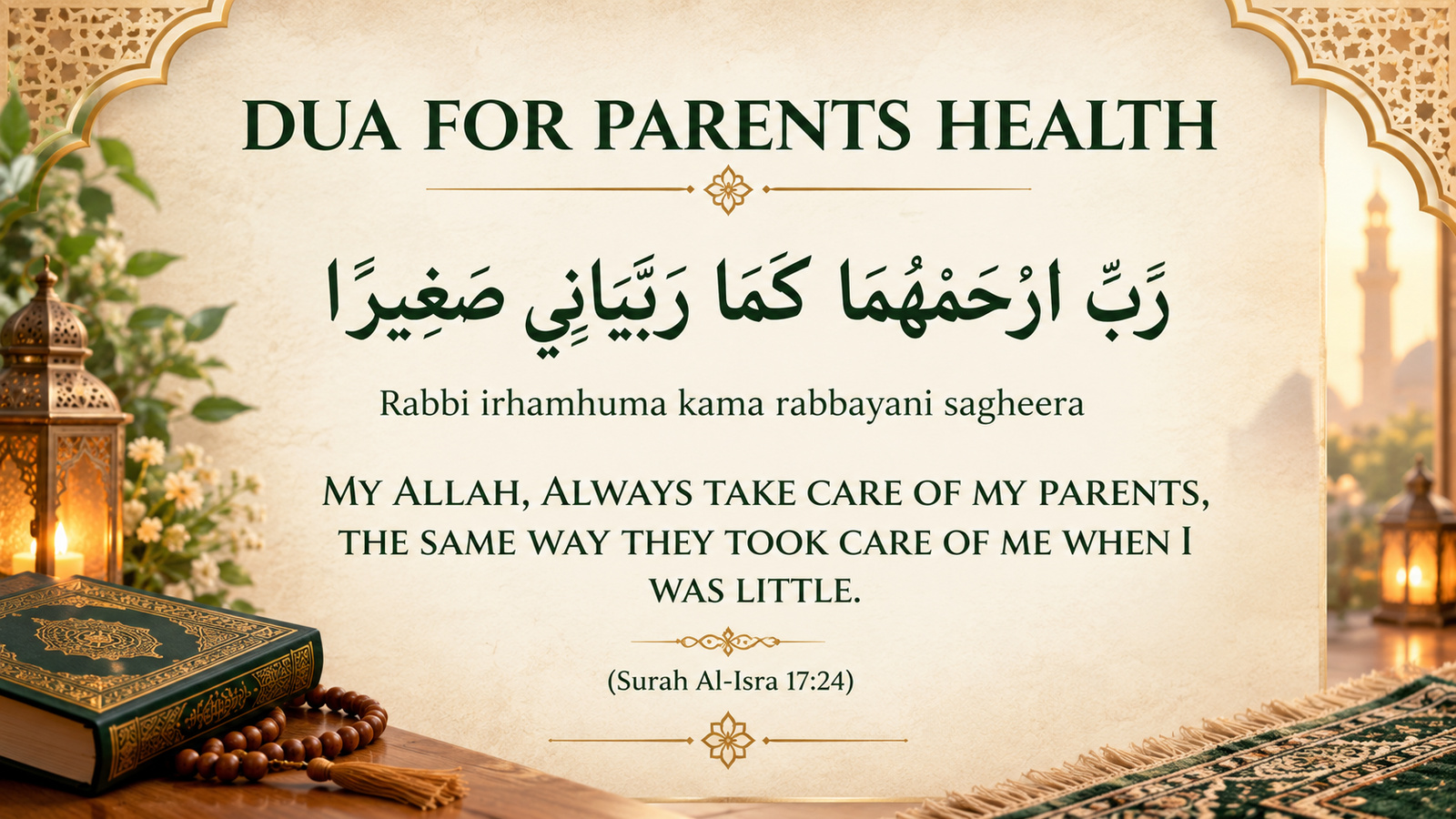
Arabic: رَّبِّ ارْحَمْهُمَا كَمَا رَبَّيَانِي صَغِيرًا
Transliteration: Rabbir hamhuma kama rabbayani sagheera
English Translation: “My Lord, have mercy upon them as they raised me when I was small.”
This is the foundational dua for mother and father in Arabic that every Muslim should have memorized. It is short enough to recite during a commute, in a moment of grief, or in the quiet minutes before sleep. Yet it carries the full weight of a child’s love, gratitude, dua for parents and intercession for their parents before Allah.
Dua for Living Parents: Supplications While They Are Still With You
Many Muslims think of praying for parents primarily in the context of death. That is a mistake. Islam places enormous emphasis on making supplication for your parents while they are alive, while you can still look them in the eye, serve them directly, and let your prayer for them run alongside your daily service to them.
The dua for living parents is about celebrating their presence, protecting them through supplication, and actively seeking goodness for them in this life and in the next.
Comprehensive Supplication for Both Parents
Beyond Rabbir hamhuma, there is a longer supplication that many scholars recommend for living parents specifically:
Arabic: اللَّهُمَّ اغْفِرْ لِي وَلِوَالِدَيَّ وَارْحَمْهُمَا كَمَا رَبَّيَانِي صَغِيرًا
Transliteration: Allahumma ighfir li wa li walidayya warhamhuma kama rabbayani sagheera
English Translation: “O Allah, forgive me and my parents, and have mercy on them as they raised me when I was small.”
This version is particularly meaningful because it includes yourself in the supplication alongside your parents. It reflects a mature spiritual awareness that you, too, are in need of Allah’s mercy, dua for parents and that seeking forgiveness together as a family unit is an act of humility and love.
When Your Parents Are Elderly or Unwell
If your parents are aging, ill, or struggling, their need for your supplication becomes even more urgent. In practice, this is the moment when many Muslims feel the limitations of what they can physically do for their parents and turn to dua with new urgency. That urgency is spiritually appropriate.
A specific supplication for a parent who is ill is derived from the practice of the Prophet (peace be upon him) when visiting the sick. He would say:
Transliteration: Allahumma rabban-naasi, adhhibil-ba’sa, washfi antash-shaafi, la shifa’a illa shifa’uk, shifa’an la yughadiru saqama
Translation: “O Allah, Lord of mankind, remove the hardship, grant healing, for You are the Healer. There is no healing except Your healing, a healing that leaves no illness behind.”
Reciting this for a parent who is suffering is one of the most direct and sincere forms of the parent supplication tradition.
Dua for Parents Who Have Passed Away

The moment a parent dies, a child’s ability to earn reward on their behalf narrows significantly. But it does not close. In fact, making dua for deceased parents is one of only three actions that continue to benefit a person after death, according to a hadith narrated by Abu Hurairah (RA) in Sahih Muslim. The Prophet (peace be upon him) said that when a person dies, their deeds come to an end except through three channels: ongoing charity, beneficial knowledge, or a righteous child who prays for them.
That last phrase places the dua of a righteous child in extraordinarily elevated company.
Specific Supplications for Deceased Parents
The most commonly recommended supplication for a parent who has passed is derived directly from Surah Ibrahim (14:41):
Arabic: رَبَّنَا اغْفِرْ لِي وَلِوَالِدَيَّ وَلِلْمُؤْمِنِينَ يَوْمَ يَقُومُ الْحِسَابُ
Transliteration: Rabbana ighfir li wa li walidayya wa lil mu’mineena yawma yaqumul hisab
Translation: “Our Lord, forgive me and my parents and the believers on the Day when the account is established.”
This is the supplication attributed to Prophet Ibrahim (AS), dua for parents and its inclusion in the Quran signals its permanent validity and deep spiritual resonance. You are not just asking for your parents. You are joining a chain of intercession that stretches back to one of the greatest prophets in history.
The Emotional Reality of Praying for a Deceased Parent
Many Muslims who have lost a parent describe the experience of making dua for them after death as simultaneously painful and comforting. The mistake some people make is feeling that once a parent has died, the relationship is over. Islamic theology rejects that entirely. Your supplication reaches them. Your dua for a deceased mother or father is a living thread of connection that spans this world and the next.
If you have lost a parent, making their dua a consistent part of your daily prayers is one of the most meaningful things you can do. It honors them, dua for parents it earns you reward, and it keeps the spiritual bond intact.
When to Make Dua for Parents for Maximum Acceptance
Knowing the right supplication is one part of the equation. Knowing when to make it is the other. Islamic scholarship identifies specific windows of time when dua is especially likely to be accepted, dua for parents and deliberately targeting those windows for your parent supplications is both strategic and spiritually intelligent.
The Best Times to Recite Parent Supplications
Use these specific, high-value windows to make your dua for parents a consistent practice:
- After every obligatory prayer (salah): The period immediately following each of the five daily prayers is one of the most receptive times for supplication. Recite Rabbir hamhuma kama rabbayani sagheera as a closing dua after every salah without exception.
- During the last third of the night: The Prophet (peace be upon him) said that Allah descends to the lowest heaven during the last third of the night and asks who is calling upon Him so He may answer. (Bukhari and Muslim). If you wake for Tahajjud, direct a portion of that time specifically toward your parents.
- On Friday before Maghrib: Many scholars identify an accepted hour on Fridays when duas are answered. The most commonly referenced window is the final hour before Maghrib. Use that time with intention.
- During sujood (prostration): The Prophet (peace be upon him) said, “The servant is closest to his Lord when in prostration.” (Sahih Muslim). Adding the parent supplication in your own language during or immediately after sujood is a practice that numerous scholars have explicitly encouraged.
- When it rains: A lesser-known sunnah is that dua during rainfall is accepted. The next time it rains, step outside for a moment and pray for your parents.
Short and Easy Dua for Parents That Anyone Can Memorize
One of the most practical features of Islamic supplication is its accessibility. You do not need to be a scholar to make a meaningful dua for your parents. Some of the most powerful prayers are also the shortest ones. What matters to Allah is the sincerity behind the words, dua for parents not the length of the sentence.
This is especially relevant for children learning to pray for their parents, for new Muslims finding their footing, and for anyone who wants to build a consistent habit before adding more complex supplications.
Simple Daily Supplications for Children and New Muslims
Start with the foundational Quranic dua. Teach it, memorize it, and repeat it every single day:
Arabic: رَّبِّ ارْحَمْهُمَا كَمَا رَبَّيَانِي صَغِيرًا
Transliteration: Rabbir hamhuma kama rabbayani sagheera
Translation: “My Lord, have mercy upon them as they raised me when I was small.”
If you are a parent teaching children to make dua for grandparents, this is the supplication to start with. It is short, it comes directly from the Quran, and its meaning is simple enough for a child to genuinely understand and feel.
Once this becomes automatic, you can layer in the longer version that includes seeking forgiveness. Over time, you can incorporate the Surah Ibrahim supplication and the specific dua for sick parents. But the Rabbir hamhuma dua alone, said consistently and sincerely every day, dua for parents is more valuable than ten longer supplications said occasionally and without focus.
Common Mistakes Muslims Make When Praying for Their Parents
The biggest mistake is inconsistency. Many Muslims make dua for parents intensely during moments of crisis, such as a parent’s illness, a parent’s death, or a personal spiritual high during Ramadan, dua for parents and then let the practice fade during ordinary life. That inconsistency misses the entire point.
The Prophet (peace be upon him) said, “The most beloved deeds to Allah are those done consistently, even if they are small.” (Bukhari and Muslim). A brief, sincere dua for your parents after every salah, done every single day of your life, accumulates a reward that occasional, emotional supplications cannot match.
Another common misconception is that dua for parents only matters after they have died. In practice, the opposite is true. While your parents are alive, dua for parents your supplication for them is an active investment in their wellbeing, in your relationship with them, and in your own spiritual standing with Allah. Do not wait until it is too late to make it a habit.
Key Takeaways
- The dua for parents from Surah Al-Isra (17:24), “Rabbir hamhuma kama rabbayani sagheera,” is the foundational supplication every Muslim should memorize and recite daily.
- Making supplication for your parents is not a cultural tradition but a documented religious obligation ranked alongside the highest acts of worship in both the Quran and the authenticated Sunnah.
- Dua for living parents and dua for deceased parents serve different but equally important spiritual functions. Do not reserve this practice only for times of grief or loss.
- The best times to make dua for parents include after every obligatory prayer, during the last third of the night, in sujood, and during the accepted hour on Friday.
- Consistency matters more than length. A short, sincere supplication said every day outweighs occasional longer ones in both prophetic guidance and practical spiritual impact.
Frequently Asked Questions
What is the best dua for parents in Islam?
The best dua for parents is the one found directly in the Quran in Surah Al-Isra (17:24): “Rabbir hamhuma kama rabbayani sagheera,” which translates as “My Lord, have mercy upon them as they raised me when I was small.” It comes from divine revelation, it is comprehensive in what it asks for, and it is short enough to recite consistently every day. Islamic scholars including Sheikh Ibn Uthaymeen have described it as encompassing all forms of good a parent could need.
Can I make dua for my parents if they are non-Muslim?
You can make dua for the worldly wellbeing of non-Muslim parents, asking Allah to grant them health, protection, and provision. However, the scholarly consensus, based on Surah At-Tawbah (9:113), is that a Muslim cannot ask Allah for the forgiveness of a parent who died as a non-Muslim. You can still serve them, care for them, and pray for their guidance while they are alive. Ibn Taymiyyah and Ibn Kathir both addressed this nuance in their works.
What is the best dua for parents in Islam?
The best dua for parents is:
رَبِّ ارْحَمْهُمَا كَمَا رَبَّيَانِي صَغِيرًا
Rabbi irhamhuma kama rabbayani sagheera.
Meaning: “My Lord have mercy upon them as they brought me up when I was small.” (Surah Al-Isra 17:24)
Can I make dua for my parents every day?
Yes I can make dua for my parents every day. Islam encourages children to pray for their parents and ask Allah to bless them with mercy, health, forgiveness and happiness.
Can I make dua for my parents?
Yes I can make dua for my parents. Ask Allah to forgive them have mercy on them grant them Jannatul Firdaus and illuminate their graves.
Will Allah accept my dua for my parents?
Allah hears every dua. Keep praying for my parents with faith, sincerity and patience and trust, in Allahs mercy and wisdom.








Leave a Reply