
Dua for Parents Health: Arabic Text, Transliteration, and Full Meaning
Millions of Muslims recite a dua for parents health every single day, yet most have never been taught why this particular supplication carries such extraordinary weight in Islamic theology. This guide gives you the authentic Arabic text, precise transliteration, full meaning, and the scholarly context behind every supplication so you can pray with genuine understanding and confidence.
Why Dua for Parents Health Is One of Islam’s Most Important Acts of Worship
Islam does not treat the wellbeing of parents as a personal preference. It treats it as a religious obligation. The Quran links honoring parents directly to worshipping Allah alone, placing them side by side in Surah Al-Isra (17:23). That pairing is not accidental. It signals that caring for your parents, including praying for their health, dua for parents health sits at the very core of what it means to live as a believer.
The Prophet Muhammad (peace be upon him) stated plainly in Sunan al-Tirmidhi (Hadith 3371): “Dua is worship.” When you raise your hands and ask Allah to protect your mother’s health or restore your father’s strength, you are performing an act of worship, not simply expressing a wish. That distinction changes everything about how you approach these supplications.
In practice, the dua for parents health serves three simultaneous purposes:
- It is an act of gratitude, acknowledging what your parents sacrificed to raise you
- It is an act of obedience, fulfilling a Quranic directive to honor them
- It is an act of mercy, channeling Allah’s rahma toward people who may never know you prayed for them
A 2014 study published in the Journal of Muslim Mental Health found that Muslims who regularly engaged in spiritual practices such as supplication for family members reported significantly lower caregiver stress and higher emotional resilience when caring for elderly parents. The benefits of sincere dua are not abstract. They are measurable in real human lives.
The Quranic Foundation: Dua for Parents in the Quran
The most authoritative source for any Islamic supplication is the Quran itself, and Allah (SWT) has given believers a direct, precise dua for parents health rooted in Surah Al-Isra.
Surah Al-Isra, Verse 24: The Core Supplication
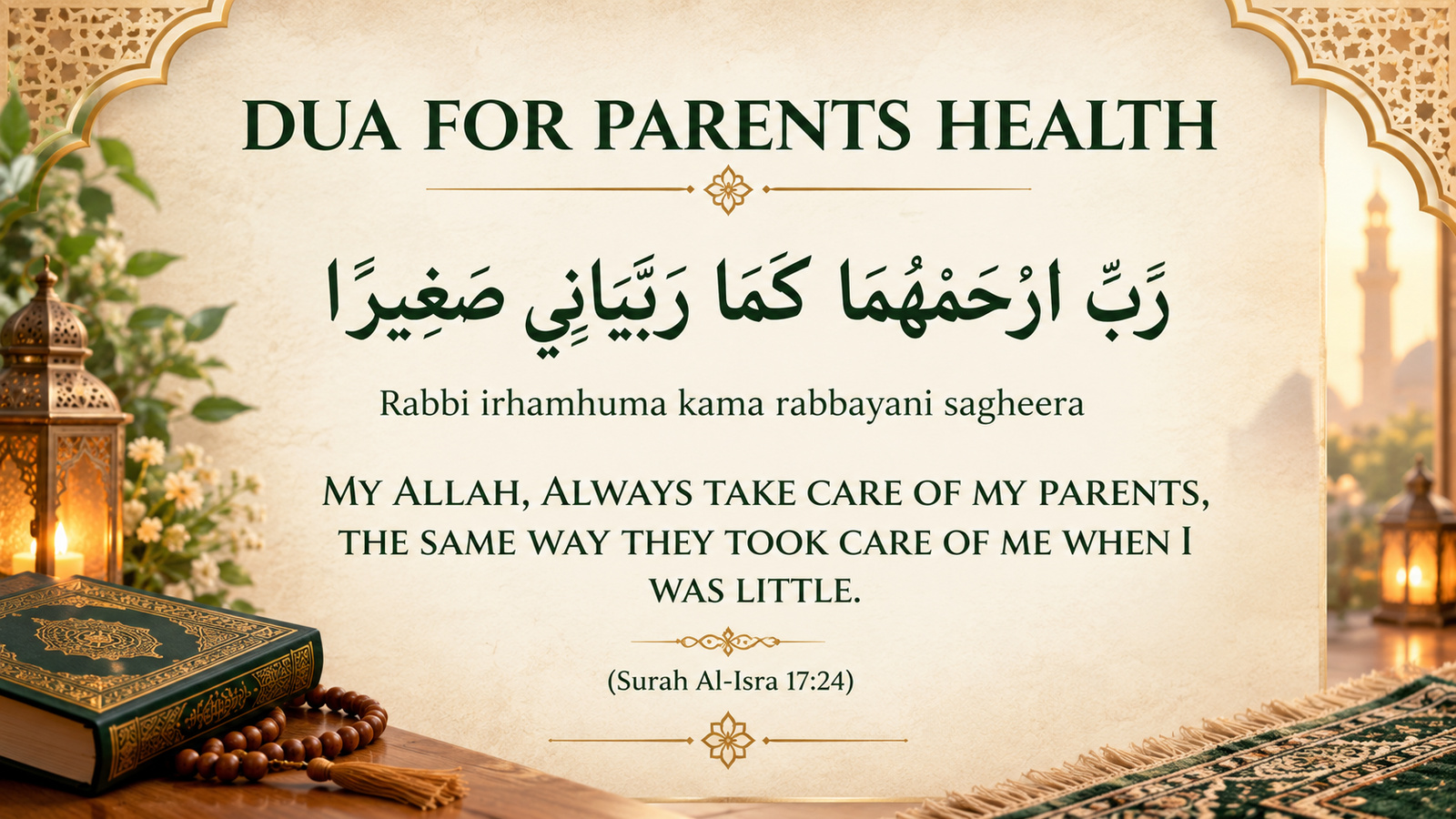
The most widely recognized dua for parents in the Quran comes from Surah Al-Isra (17:24). Classical commentators including Ibn Kathir and Al-Qurtubi both emphasize that this verse was revealed specifically to establish the rights of parents and to teach believers how to honor them through active supplication, dua for parents health not passive sentiment.
Arabic text:
رَبِّ ارْحَمْهُمَا كَمَا رَبَّيَانِي صَغِيرًا
Transliteration:
Rabbir hamhuma kama rabbayani saghira
Meaning:
“My Lord, have mercy upon them as they raised me when I was small.”
This supplication is short enough to memorize in a single sitting, yet its theological depth is enormous. The word “irham” derives from the root “rahma,” the same root as “Rahman” and “Rahim” in Bismillah. You are asking Allah to extend toward your parents the same quality of mercy that defines His own nature. Scholars at Al-Azhar University, founded in 970 CE and one of the oldest centers of Islamic learning in the world, consistently describe this as the foundational Islamic prayer for parents health because it encompasses physical wellbeing, dua for parents health emotional peace, and divine protection in a single phrase.
Surah Al-Isra, Verse 28: When You Cannot Be Present
Many Muslims face the practical reality of living far from their parents due to work, migration, or circumstances beyond their control. For those individuals, this supplication from Surah Al-Isra (17:28) carries particular relevance:
Arabic text:
وَقُل لَّهُمَا قَوْلاً كَرِيمًا
Meaning:
“And speak to them a noble word.”
While this verse is not a dua in the grammatical sense, dua for parents health Islamic scholars treat it as a directive that includes making noble supplications on your parents’ behalf when physical presence is impossible. The act of praying for your parents’ long life and good health from a distance fulfills this commandment in a profound way.
The Most Authentic Arabic Duas for Parents Health: Full Text and Transliteration
Authenticity is the single most important criterion when selecting a supplication. Below are the three most well-established Arabic duas for parents, each traceable to the Quran or authenticated hadith collections.
Dua 1: The Comprehensive Supplication for Parents (Surah Al-Isra)
This expanded version of the Quranic dua incorporates forgiveness alongside mercy, making it a comprehensive Islamic prayer for parents health and spiritual wellbeing.
Arabic text:
اللَّهُمَّ اغْفِرْ لِي وَلِوَالِدَيَّ وَارْحَمْهُمَا كَمَا رَبَّيَانِي صَغِيرًا
Transliteration:
Allahumma ighfir li wa liwalidayya war hamhuma kama rabbayani saghira
Meaning:
“O Allah, forgive me and my parents, and have mercy upon them as they raised me when I was small.”
In Islamic theology, dua for parents health divine mercy encompasses health, provision, and protection simultaneously. When you ask for rahma on behalf of your parents, you are asking Allah to cover every dimension of their wellbeing, including physical healing. This is why scholars recommend reciting this version after every obligatory prayer.
Dua 2: The Healing Supplication for Ill Parents
When a parent faces a specific illness or medical condition, the Prophet Muhammad (peace be upon him) taught a dedicated supplication for recovery. Recorded in both Sahih al-Bukhari (Hadith 5743) and Sahih Muslim (Hadith 2191), this is among the most authenticated healing duas in the entire Islamic tradition.
Arabic text:
اللَّهُمَّ رَبَّ النَّاسِ، أَذْهِبِ الْبَأْسَ، اشْفِ أَنْتَ الشَّافِي، لَا شِفَاءَ إِلَّا شِفَاؤُكَ، شِفَاءً لَا يُغَادِرُ سَقَمًا
Transliteration:
Allahumma Rabb an-nas, adhhib al-ba’s, ishfi anta ash-Shafi, la shifa’a illa shifa’uka, shifa’an la yughadiru saqama
Meaning:
“O Allah, Lord of mankind, remove the affliction. Heal, for You are the Healer. There is no healing except Your healing, a healing that leaves no illness behind.”
The mistake most people make here is treating this dua as a generic formula. Notice the precision in the phrasing: “a healing that leaves no illness behind.” This is a request for complete restoration, dua for parents health not temporary relief. When you recite this as a dua for parents long life and full recovery, you are invoking one of the most specific and powerful supplications the Prophet (peace be upon him) ever taught.
Dua 3: The Supplication for Parents’ Long Life and Guidance
This supplication, widely used across scholarly communities and recommended by contemporary Islamic jurists, asks for both longevity and continued spiritual wellbeing for parents.
Arabic text:
اللَّهُمَّ أَطِلْ عُمُرَهُمَا فِي طَاعَتِكَ وَأَصْلِحْ أَعْمَالَهُمَا وَاجْعَلْ خَاتِمَتَهُمَا خَيْرًا
Transliteration:
Allahumma atil umurahuma fi ta’atika wa aslih a’malahuma waj’al khatimatahumma khayra
Meaning:
“O Allah, extend their lives in Your obedience, rectify their deeds, and make their endings good.”
This supplication for parents in Islam is particularly meaningful for children who watch their parents age. It asks not just for more years, dua for parents health but for those years to be spiritually productive and for death, when it comes, to arrive with peace and faith intact.
How to Recite Dua for Parents Health Correctly
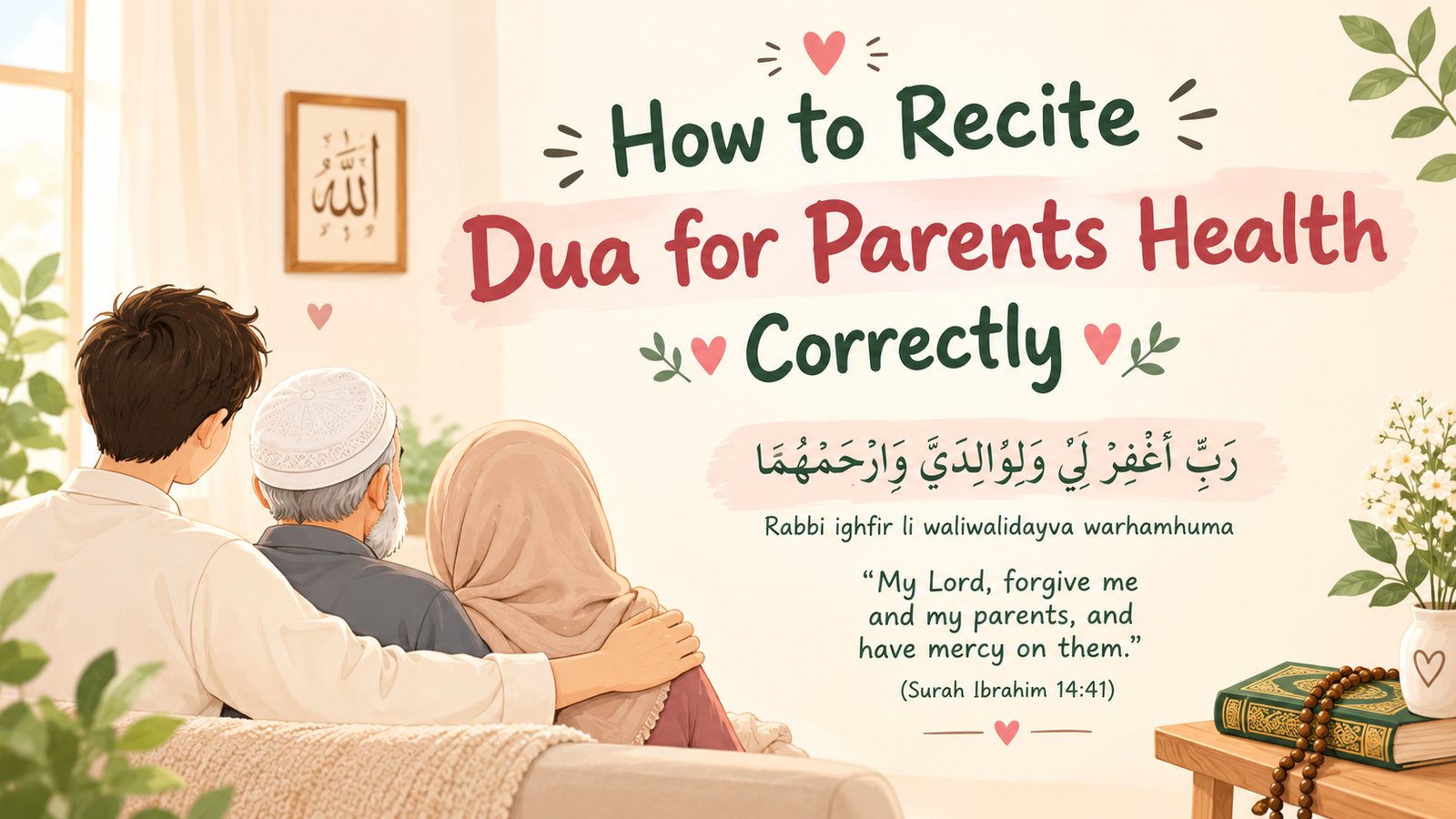
Knowing the words is only half the equation. Knowing how and when to recite them determines whether your supplication reaches its full spiritual potential.
The Conditions That Strengthen Any Dua
Islamic scholars across the Hanafi, Maliki, Shafi’i, and Hanbali schools agree on a set of conditions that increase the likelihood of a supplication being accepted. These are not requirements for validity but practices that amplify sincerity and spiritual receptivity:
- Begin with Bismillah and send blessings on the Prophet (peace be upon him)
- Face the qibla if possible
- Raise your hands with palms facing upward
- Call upon Allah using His Beautiful Names (for health, use “Ya Shafi” or “Ya Rahman”)
- Acknowledge your own shortcomings before making your request
- Repeat the supplication three times
- Close with salawat (blessings on the Prophet) and say Ameen
The Best Times to Make Dua for Your Parents
Timing matters in Islamic supplication. Here are the windows when dua is most likely to be accepted, according to authenticated hadith:
The last third of the night: The Prophet (peace be upon him) said in Sahih Muslim that Allah descends to the nearest heaven during this time and asks who is calling upon Him
Between the adhan and iqama: A brief but powerful window before the congregational prayer begins
After the obligatory prayers: Many scholars specifically recommend reciting the Surah Al-Isra dua at this point each day
On Friday: The Prophet (peace be upon him) indicated in Sahih al-Bukhari that Friday contains an hour during which no Muslim asks Allah for good except that He grants it
During prostration (sujud): The Prophet (peace be upon him) said in Sahih Muslim: “The closest a servant is to his Lord is when he is in prostration, so make plenty of supplication”
In practice, if you want to build a consistent habit, attach the dua for parents health to an existing daily anchor. Reciting it immediately after Fajr and Maghrib prayers takes less than thirty seconds and creates a daily spiritual investment in your parents’ wellbeing.
Pronunciation Guidance for Non-Arabic Speakers
One of the most common concerns among Muslims raised outside Arabic-speaking environments is mispronouncing the Quranic dua for parents. Here is the honest truth: Allah responds to sincere hearts, and scholarly consensus across all four major madhabs confirms that a genuine attempt at correct pronunciation is accepted even when imperfect.
That said, improving pronunciation is a worthy goal. These practical steps work:
- Listen before you recite using platforms like Quran.com, which provides audio from verified reciters
- Focus on the letters that have no English equivalent, particularly “ح” (ha), “ع” (ain), and “خ” (kha)
- Learn the short vowel markings (harakat) because they change meanings significantly in Arabic
- Use apps like Tarteel AI or enrol in a local mosque tajweed class for structured feedback
- Record yourself and compare your pronunciation to a verified recitation weekly
The Spiritual and Practical Impact of Regular Supplication for Parents
Here is something the wider conversation around Islamic prayer often misses: the person who makes a dua for parents health is transformed by the act itself. You cannot sincerely ask Allah to have mercy on your mother without softening your own heart toward her. You cannot genuinely pray for your father’s recovery without becoming more attentive to his daily needs.
The Prophet Muhammad (peace be upon him) mentioned in Sahih Muslim (Hadith 1631) that three deeds continue to benefit a person after death. One of them is “a righteous child who prays for them.” This means your supplication for your living parents is simultaneously building your own spiritual legacy. The rewards flow in both directions.
What this means for you practically is this: even if you feel spiritually distant, even if your relationship with your parents is complicated, even if you are carrying grief or frustration, dua for parents health the act of making a consistent dua for parents long life and wellbeing is itself a path back to sincerity. Islamic scholars describe supplication not just as a response to closeness with Allah but as a means of achieving it.
Common Misconceptions About Dua for Parents in Islam
Misconception 1: Only Specific Words Count
Some Muslims believe only the exact Quranic text qualifies as a valid supplication for parents in Islam. This is not accurate. While Quranic duas carry the highest authenticity and spiritual weight, the Prophet (peace be upon him) encouraged believers to also make personal supplications in their own languages. You can recite the Arabic text and then follow it with sincere personal words asking Allah to protect your parents’ health in whatever language comes most naturally to your heart.
Misconception 2: Dua Is Only for Crisis Moments
Many people reach for supplication only when a parent falls seriously ill. That reactive approach misses the Sunnah model entirely. The Prophet (peace be upon him) taught consistent, dua for parents health proactive supplication as a form of ongoing worship. Making the dua for parents health daily, whether your parents are well or unwell, is the authentic practice.
Misconception 3: Your Sins Prevent Your Dua from Being Heard
This is a particularly harmful misconception because it stops people from supplicating at their most vulnerable moments. The scholarly consensus is clear: Allah hears every supplication. Whether and how He responds depends on His infinite wisdom. Your sins do not create a barrier between your dua and Allah. They may affect the form of the response, dua for parents health but they never prevent the supplication from reaching Him.
Key Takeaways
- The dua for parents health rooted in Surah Al-Isra (17:24) is the most authenticated and widely recommended supplication in Islamic tradition, traceable directly to the Quran
- The healing dua from Sahih al-Bukhari (Hadith 5743) is the most specific supplication for parents facing illness and asks for complete, dua for parents health lasting recovery
- The best times to recite any supplication for parents in Islam include the last third of the night, after obligatory prayers, during sujud, and on Fridays
- Non-Arabic speakers should prioritize sincere intention alongside consistent pronunciation practice, using platforms like Quran.com and Tarteel AI for guidance
- Making a regular Islamic prayer for parents health benefits both the parents and the child spiritually, dua for parents health with the Prophet (peace be upon him) confirming that a righteous child’s prayer continues to benefit parents even after death
Frequently Asked Questions
What is the most authentic dua for parents health from the Quran?
The most authentic dua for parents health is from Surah Al-Isra (17:24): “Rabbir hamhuma kama rabbayani saghira,” meaning “My Lord, have mercy upon them as they raised me when I was small.” It comes directly from the Quran, making its authenticity absolute. Scholars across all four major schools of Islamic jurisprudence recommend reciting it after every obligatory prayer.
Can I make dua for parents health in English or my own language?
Yes. While Arabic duas carry the highest spiritual weight because of their direct Quranic or Prophetic origin, Islamic scholars unanimously agree that personal supplications in any language are valid and heard by Allah. The recommended approach is to recite the authentic Arabic text first and then follow it with sincere personal words in whatever language allows you to speak from the heart most freely.
How often should I recite a dua for parents long life and good health?
The Sunnah model is daily, consistent supplication rather than occasional prayer during crisis moments only. Most Islamic scholars recommend reciting the Surah Al-Isra dua after Fajr and Maghrib prayers as a minimum. Adding it during the last third of the night, in sujud, or between the adhan and iqama on Fridays maximizes the spiritual impact of your supplication for parents in Islam.








Leave a Reply